As-Built Drawing Survey Sydney: LiDAR Verification for Construction Projects
An as-built drawing needs to be accurate, fast, and contractually defensible. GeoAI uses mobile LiDAR scanning to deliver as-built data at surveyor-certified accuracy. This article explains what an as-built survey is, why it matters at practical completion, and what Sydney asset owners and councils actually require at handover.
What Is an As-Built Drawing Survey?
An as-built drawing survey records a structure or site as it was actually constructed. It captures the final position of every element such as walls, columns, slabs, services, and infrastructure, regardless of what the original design drawings specified.
Design drawings represent intent to build. As-built data represents reality. Therefore, the two rarely match perfectly. Small deviations accumulate throughout construction. An as-built drawing survey captures those deviations and creates a verified spatial record of what was built.
Why As-Built Data Is Not Optional
In New South Wales, as-built documentation is a contractual requirement on most projects. Consequently, it directly affects practical completion sign-off, occupation certificate applications, and the handover of infrastructure assets to councils or utility authorities.
Furthermore, inaccurate or incomplete as-built data creates problems that extend well beyond handover. During the defects liability period, disputes about whether an element was built to specification require spatial evidence. Without a verified as-built record, those disputes are difficult to resolve objectively.
Asset owners also rely on as-built data for long-term operations and maintenance. For example, a facility manager locating a buried service or planning a future renovation needs accurate spatial coordinates. The do not need a planning design coordinates that may differ by 50 mm or more from actual construction.
How GeoAI Delivers an As-Built Drawing Survey Sydney Projects Need
GeoAI uses vehicle-mounted and handheld mobile LiDAR scanners to capture complete site geometry in a single pass. The scanner emits millions of laser pulses per second. Each pulse returns a precise distance measurement. The result is a dense, georeferenced point cloud covering every visible surface on the site.
Faster Than Traditional Survey Methods
Traditional as-built drawing surveys rely on total stations and manual measurement of individual points. A complex building floor may take a surveyor one to two days to measure. In contrast, GeoAI can capture the same floor in under two hours with a handheld LiDAR unit.
Moreover, traditional methods capture only what the surveyor physically measures. LiDAR captures everything simultaneously. As a result, no element is missed because it was inconvenient to access or outside the survey scope at the time.
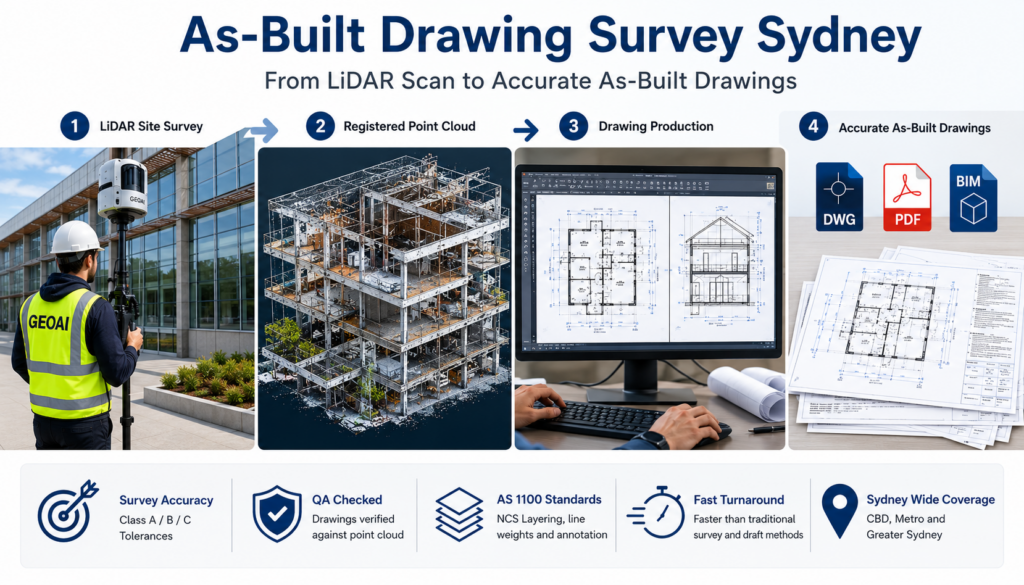
Survey Accuracy Tolerances
Australian survey standards define accuracy classes for as-built and infrastructure surveys. Understanding these classes helps builders and engineers confirm that GeoAI’s deliverables meet their contractual requirements.
GeoAI’s mobile LiDAR platform achieves positional accuracy of ±10 mm for structural elements. This accuracy inline well within Class A requirements. Furthermore, all data is georeferenced to a known coordinate system. Therefore, it is directly comparable against design files and can support formal surveyor certification where required.
What Sydney Councils and Asset Owners Require
Most Sydney councils require as-built documentation before they accept infrastructure assets. The types of infrastructure includes roads, stormwater, sewer, and public domain works. Specifically, councils commonly require:
- Georeferenced plans in MGA2020 coordinate system
- Invert levels for drainage and sewer pits to ±10 mm
- Pipe centreline locations to Class B or better
- PDF and DWG format deliverables for council GIS integration
- Certification by a registered surveyor where required by the consent conditions
In addition, developers handing over strata buildings to owners corporations increasingly need accurate spatial data for embedded network infrastructure, lift shafts, and mechanical plant rooms. GeoAI can capture and document all of these in a single mobilisation.
Comparing As-Built Data Against Your Design
Capturing as-built geometry is only half the task. The other half is comparing it against what was designed. GeoAI provides automated deviation analysis between the captured point cloud and the approved design model.
Design Comparison Workflow
GeoAI accepts design files in DWG, DXF, IFC, and RVT formats. The design is registered to the same coordinate system as the point cloud. Software then calculates the distance between every captured point and the nearest design surface. As a result, deviations appear as a colour-coded map. This deviation report gives builders clear evidence at practical completion. Furthermore, it gives certifiers and principal contractors an objective basis for accepting work, rather than relying on visual inspection alone.
As-Built Drawing Surveys at Practical Completion and the Defects Liability Period
Practical completion is one of the most contractually significant moments in any construction project. It triggers payment milestones, warranty periods, and the transfer of risk. However, it also creates a documentation obligation that many builders underestimate.
Why Timing Matters
The as-built drawing survey should be completed as close as possible to practical completion. Delay creates risk. Temporary works may be removed. Site access becomes restricted. Consequently, elements that were visible at handover become inaccessible or altered. GeoAI can mobilise quickly and complete a final as-built scan within 24 to 48 hours of practical completion. Therefore, the spatial record reflects the building exactly as handed over.
The Defects Liability Period
During the defects liability period (typically 12 months in NSW), the principal may raise defect claims against the contractor. Many disputes centre on whether an element was built incorrectly or has subsequently moved or settled.
A timestamped as-built point cloud provides objective spatial evidence. It shows the position of every element at practical completion. In contrast, a dispute without spatial evidence relies on competing verbal accounts. Moreover, a verified as-built record protects the contractor as much as it protects the principal.
Operations and Maintenance After Handover
Asset owners increasingly demand spatially accurate handover documentation for O&M purposes. Facility managers need precise locations for mechanical plant, fire services, electrical switchboards, and embedded infrastructure. GeoAI’s as-built data can be delivered in formats compatible with CAFM and IWMS platforms. As a result, the spatial record goes straight into the building’s operational systems.
As-Built Handover Checklist for Sydney Construction Projects
The following checklist covers the as-built documentation items most commonly required at practical completion in NSW. Use it to confirm your project is ready for handover.
- Georeferenced point cloud — LAS/LAZ files referenced to MGA2020
- 2D as-built CAD drawings — DWG plans, sections, and elevations
- Drainage and services as-builts — pit inverts, pipe centrelines, cover levels
- Structural deviation report — colour-coded actual vs design comparison
- Surveyor certification — signed certificate where required by consent conditions
- 3D model or mesh — for BIM handover and facilities management
- PDF report with annotated images — for certifier, council, and owner records
- Timestamp and scan date record — confirmed scan date matching practical completion
Sydney Coverage and Turnaround Times
GeoAI covers the full Sydney metropolitan area and Greater Sydney region. This includes the CBD, inner suburbs, and major growth corridors including Parramatta, the Hills District, Blacktown, Liverpool, Campbelltown, and all Sydney Metro construction zones.
For most projects, GeoAI can mobilise within 48 hours of booking. Furthermore, deliverables are typically returned within 24 to 48 hours of the scan date. Therefore, the complete turnaround from booking to final deliverable is commonly under five business days.
For urgent practical completion scans, GeoAI offers priority mobilisation. Contact the team directly to confirm availability and turnaround for time-critical handover milestones.
Ready to bring geospatial AI to your infrastructure programme?
Category List
- 3D Point Cloud
- Artificial Intelligence
- Asset Management
- Digital Twin
- Featured
- Hardware
- Knowledge Graph
- LiDAR
- News
- Site Monitoring
- Vegetation Monitoring
- Virtual Reality
Recent Post
- What Is GIS-Ready Data? How LiDAR Outputs Feed Into Spatial Systems
- Scan-to-BIM Workflow Explained: From LiDAR Point Cloud to BIM Model
- As-Built Drawing Survey Sydney: LiDAR Verification for Construction Projects
- Digital Twin for Construction Projects – How LiDAR Powers Real-Time Site Models
- Road Asset Management Sydney